
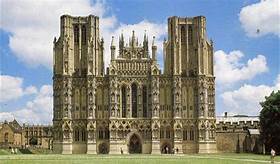
The talk printed below was first given at the Somerset Record Society AGM at the Education Room in Wells Cathedral on Saturday 9th October 2021 by Dr Robert Dunning. It gives an overview of the history of the archives of Wells Cathedral and how the Somerset Record Society has brought some of these unique documents to light. Draft minutes of the AGM are available at the bottom of our Publications page.
Early in 1311, two years after he was elected bishop, John Droxford wrote to Dean Godelee asking him to summon the Provost, the archdeacon of Taunton and Canon Anthony Bradney, executors between them of his two immediate predecessors. He was ‘much embarrassed’, he said, because as executors they held the registers of bishops March and Haselschaw and he needed them in order to carry out his duties properly. Almost a century later Nicholas Bubwith, nearly three years in the job and in the absence of Dean Richard Courtenay, ordered the Precentor, the Chancellor, the archdeacon of Bath and the vicar of St Cuthbert’s to threaten with the greater excommunication certain ‘sons of iniquity whose names were unknown’ who had ‘withdrawn, carried away, were holding and hiding … divers charters, instruments, books, agreements, sentences, judgments and other muniments’ both spiritual and temporal concerning his bishopric. Thirty years on and the archbishop of Canterbury intervened in similar vein on behalf of the newly-arrived Thomas Bekynton. Wells was evidently not a safe place for archives.
Fast forward to the 19th century, when the dreaded Ecclesiastical Commissioners, seen by some as yet more sons of iniquity, came to Wells in order to carry out their purpose of equalising ecclesiastical revenues. It’s a story that has yet to be told in proper detail, but it involved to transfer to London sometime after 1840 of such manuscripts belonging to the bishopric and the cathedral as the commissioners deemed necessary. Imagine clerks descending on the offices of the man who was both Diocesan Registrar and Chapter Clerk, and the cathedral library, though I suspect, as we shall hear, that there were other obscure rooms stuffed with papers they were never told about. Their haul will have understandably included accounts of ecclesiastical revenues which were their immediate interest, but we know it included materials going back to the 13th century because they were quite carefully listed (in civil service rather than archival fashion) and given numbers (perhaps because Wells comes at the end of the alphabet) with a bewildering number of digits. They were divided generally between those belonging to the dean and chapter, the bishop, the dean, the vicars choral, the archdeacon of Wells, the precentor and the sub-chantry. The lists, bound in bright blue cloth and clearly typed passed to the then Somerset Record Office in 1964 with the first returned documents and which are still the key to the massive collection. It was one entry in those lists which caught my eye and I will tell you about later.
Inevitably, the Commissioners held on to things that still might be useful after the first transfer, and I found myself visiting their offices in search of material for land they still held once part of the episcopal estate in Huish Episcopi. What I found, among other things, was a document numbered Report 127551/2, which was a survey of the estate made in 1858 prior to the sale of most of it in the following year. Whether that is now in Somerset I have not checked.
So, several thousand documents left their various homes in the city for London and the Commissioners proceeded, evidently with some sympathy towards those who felt their rather comfortable world was under threat. The holders of the endowed prebends were permitted to retain them for life, Richard Beadon enjoying his ample prebend of Wiveliscombe for half a century; and Wells, in the end, did not find itself forced to join Bristol to save a bishop for Manchester or Ripon. It did, however, put money into a theological college, whose students occupied rooms over the west cloister for lectures, the very rooms where the dean’s registrar stored papers that were used (so Thomas Serel declared) for lighting the students’ fire.
So enter Thomas Serel, sometime bookseller in the city but also perhaps legal clerk with Wells Corporation and the Diocesan Registrar, some of whose business was done by James Prat of Wells and Glastonbury as one of two deputy diocesan registrars. From about 1840, so Serel later told the Somerset Archaeological Society, he began to buy interesting historical documents that came his way, beginning at ‘Mr Prat’s’ sale in that year, and much later, in 1870 papers at the sale of the effects of the later Bishop Lord Auckland which included several boxes of documents once belonging to Bishop Law. Serel also described how he had found a Wells butcher using an old register of wills to wrap his meat in – that was probably after 1858 when probate business was transferred from ecclesiastical courts.
A later story was told of a clerk in the Registry who had sold documents to a dealer in Bath. If this too was Serel, he may have been selective, for he retained a great deal and 100 volumes passed to the Somerset Archaeological Society through (so his obituary) ‘his vigilant care and unostentatious labours in rescuing a large number of valuable MSS relating to the See, the corporation of Wells, the college of Vicars Choral and the principal county families which in many instances would otherwise have been lost or destroyed’. The papers include those rescued from the butcher, parts of more than one register of wills and the records of Wells deanery and the chapter Peculiar of Bishop’s Lydeard.
Serel may have been prompted to tell his story in 1871 because another royal commission, that of Historical Manuscripts, published its first survey relating to Wells describing in very summary fashion what was still remaining of the archives of the bishop, the dean and chapter and the corporation. Henry Thomas Riley, one of the commission’s officers, found at the cathedral ‘a mass of parchments almost wholly without arrangement and in varying stages of preservation’. He evidently had to pay a second visit because more material mysteriously turned up, and a later search produced a large box, said to be full of rubbish but containing a thousand ancient documents. Serel’s reaction was to call for a systematic index of historical records across the county.
The riches unearthed at the cathedral (minus, of course, what the Ecclesiastical Commissioners had carted away, the college students had burned and Thomas Serel in his inimitable way had rescued) included the great volumes of copies of the cathedral’s charters, called Liber Albus i and ii and Liber Ruber, some original deeds, Chapter Acts, ledger books, ministers’ accounts from 1327 and other documents, mostly dating from the 16th century. The Chapter in 1881 employed Walter de Gray Birch of the British Museum to catalogue and box the deeds, and in the following year the Manuscripts Commission set another of its officers, this time a Somerset parish clergyman, to produce something much more substantial. This was the Revd James Bennett, vicar of South Cadbury, who had worked for the Commission on other collections across the country. Bennett worked very closely with the canon librarian, Charles Marcus Church, formerly Principal of the College and later subdean. The next part of my story can be told from letters belonging to our own Record Society.
‘My dear Jim’, wrote Canon Church to James Bennett on 23 February 1885, ‘You will be grieved to hear that Mr Dore the Registrar died almost suddenly yesterday – heart complaint. It is a loss of a good upright man, very courteous in his office – to me. I have written to B[isho]p Hobhouse [formerly bishop of Nelson, New Zealand] to ask information as to the procedure at Lichfield on vacancy of the office – when will you be coming up for another oversight. We must arrange for a careful chronological arrangement of books and loose papers in the Chapter Office … I hope there will be something in print by the Easter Chapter.’ On the same day Scott Holmes write from Wookey Vicarage: ‘Dear Bennett, I hear that Dore of the Registry is dead; went off suddenly today, so I am going to write to the Bishop, to ask him to allow an inventory to be taken of the contents of the office before a new Registrar is appointed. Our antiquarian researches will be much assisted when we know exactly what there is in that mine. Back me up by writing yourself and telling him of the inconvenience of being ignorant of the contents of the office …’
William Dore had been Registrar for at least twenty years and his death was an obvious opportunity for Church and Bennett; and Bishop Hobhouse, who lived at Batcombe since his retirement from Lichfield, where he had for a time been Chancellor, was the obvious man to be involved.
Three days after those two letters were despatched the lawyer-antiquarian John Batten was also urging Bennett to ask the Bishop ‘in his appointment of a new Registrar to have an understanding that no fees should be charged to researchers of his records for literary purposes which has not been the case hitherto’.
Bennett’s careful letter two days later (preserved in draft) admitted that he had ‘for a long time been anxious for a complete calendar of the contents of the [bishops’] registers, but under the past system it was practically impossible to plan this (of course I do not imply the slightest blame to Mr Dore) …’ The Bishop replied the very next day, a Sunday, to say that he had already appointed a Mr Harris to be his Registrar – the first Harris of Harris & Harris. All done within a week.
Still, the Bishop appeared co-operative: ‘I shall be very glad to arrange with him [Mr Harris] for some system by which the Registry can be made useful in the interest of History and Archaeology … I have already told him that I wish an Index or Calendar to be made. If you could give any help in this with Mr Taylor the Clerk to work under your directions it might greatly facilitate matters. Would you send me a definite scheme which I could propound to Mr Harris?’
Then came the rub: ‘I should object to any documents being taken out of the office as the risk is so great and when I consulted Lord Coleridge on the point last year, he said that he thought the Registrar ought not to allow them to go out of his custody. But it would be easy to arrange for copying documents at the office with a special rate of moderate fees for the week or month or quarter … Mr Holmes of Wookey has also volunteered to help …’ Mr Bennett consulted none other than his friend the Bishop of Chester, the eminent Bishop Stubbs, but the Bishop would not budge, partly because he had another battle on his hands: Canon Church, egged on by Dean Plumptre, tried to block Mr Harris’s appointment by invoking the Chapter’s right to confirm his appointment; but in the end the Chapter gave way, because they could find no precedent for refusing, and confirmed the appointment of Richard Harris of Wells, solicitor of the Supreme Court, to the office of Registrar and Scribe of the Acts of the Bishop and his successors, Vicar-General in Spirituals and Commissary General and Official Principal of his Episcopal Consistory Court of Wells or elsewhere for life …’ Lord High Executioner.
The battle, of course, had been about thwarting the Bishop, not about Mr Harris, for more than a year before Dore’s death they had appointed him ‘Registrar and Scribe or Writer of the Acts’ of the Dean and Chapter’s Peculiar Ecclesiastical Jurisdictions, especially those of North Curry, Stoke St Gregory, West Hatch, Cheddar, Long Sutton, Bishop’s Lydeard, Combe St Nicholas, Winsham, Lovington, South Barrow, the Liberty of St Andrew in Wells … also safely and faithfully to keep and preserve all the Books, Registers, Acts, Exhibits, Muniments and Archives whatsoever.’ Lord High Everything Else.
And Richard Harris proved a force to be reckoned with. In June, even before the confirmation of his appointment, he wrote to James Bennett: ‘Dear Sir or Madam: I am favoured with your letter of yesterday in which you kindly offer to go through the papers in the Bishop’s Registry with me. I have however, already been through them, and so far as I have been able to ascertain they are in fairly good order, and will only require a little changed indexing. The only documents apparently that are not arranged and indexed are some very old letters which appear to be of no practical use or importance. With regard to the inspection of any Registers or other documents for the purposes of the Archaeological Society [he meant the Record Society] I am unable to make any arrangements or promises for the present as my appointment as Registrar has not yet been confirmed by the Dean & Chapter and it is thought by some persons that this is necessary… ‘ Mr Bennett was rightly alarmed, but what to say to the Bishop caused him some difficulty: two drafts survive, but he made his point, and the Bishop saw Harris and urged some sort of accommodation.
Meanwhile, of course, Bennett’s work on the cathedral MSS was dragging on and Canon Church was getting anxious. He had evidently allowed Bennett to take some of them home without Chapter’s formal approval, and since, in the course of the work, more documents had been ‘unearthed and disturbed’ (Church’s phrase) at the Chapter Office, he was determined to have them brought to the library and get them catalogued before Harris was too much involved. ‘Take warning from Harris’ speech to the Bishop’, he added.
Bishop Hobhouse admitted he was ‘sorely plexed by the Registry Rules’, but cheerfully paid Dore’s executors for charges he had incurred for private researches there except for the sum of 3s 6d for a Dinder terrier. Eventually, Bennett negotiated a deal with Harris, and Church was prepared to look at Droxford’s register, the suggested first volume for publication. In the event he could not face the daunting task and handed it back to Bennett and Hobhouse.
Now Hobhouse was proposing to move his family to the Deanery for the winter while Dean Plumptre was away, and the prospect of the bishop in Wells made Church think of the Registry as under siege and that Harris and the diocesan should be attacked. Even the mild Hobhouse described it as an invasion. Harris negotiated and proposed a fee of 1/- a day for work on the register calculated at 400 hours ‘during which’ he told Bennett, ‘you will have the use of my office and fire and a clerk to get down and put back the Register’, but he was prepared to offer a 50% discount. Hobhouse commented that fire, clerks and office would be there anyway, but the terms were grudgingly accepted and the register finally appeared in print.
Bennett’s volume of cathedral MSS also finally appeared and in the following years the Record Society produced more volumes of bishops’ registers, made possible by another sort of progress: those from Ralph of Shrewsbury onwards, thanks to the bishops after Lord Arthur Hervey, were sent to the Public Record Office in London for transcription. Mr Harris was paid an undisclosed fee on the first occasion. Sir Henry Maxwell Lyte, the Deputy Keeper of the Public Records and responsible for Bishop Bekynton’s register, in 1934 thanked Bishop Wynne Wilson ‘for most obligingly allowing the original register to be deposited … and his Registrar, Mr R G Harris, for his assistance in the matter.’ There is no trace of a fee. He later repeated his thanks to Mr Harris for ‘valuable assistance’ when Stillington’s register was ‘in London for several months.’
Mr Harris was again thanked when the registers of bishops King and Hadrian left Wells but the rest did not need to travel as Sir Henry retired to Dinder House and transcribed them himself. Dom Aelred Watkin in 1943 thanked the same Mr Harris ‘and the staff of the Registry for their help in making the Act Books of the Consistory Court available – at some trouble I am afraid to themselves.’ Mr C W Harris, known as Wyndham, RG’s son and successor, was himself a subscribing member of the Somerset Record Society; how things change!
That same Mr Harris welcomed (with no mention of a fee) a young research student in 1960, showed him the registers, kept in a wooden box in his room above the Bishop’s Eye, and then directed him to the room of his ecclesiastical clerk, Cecil Linham. There he examined the registers from Bowet to Stillington, looking particularly at the marginalia that transcribers or editors had not thought of interest. The desk he worked at was a chest of drawers and his seat a chair on casters that was difficult to keep in place on a sloping floor. Mr Linham’s particular concern at the time was that the new bishop should be persuaded not to go modern and sign himself officially by his second name, Barry, and not Edward. His other delight was to tell me his official title was Apparitor-General.
I recall in that room and corridors and staircases shelves stuffed with interesting-looking papers which looked untouched in years. Some of them had been examined, since Richard Holworthy in 1926 found the Consistory Court Act Books ‘in a very poor state’ and ‘mounted a rescue operation which involved the protection of individual volumes or broken sections of volumes between straw boards’. Those straw boards are still doing their job.
A year after my visit (though there is no connection, I am sure) there began a steady transfer of those and other records of the diocese from the Registry to the County Record Office, then at Obridge Road in Taunton, that lasted 15 years and included those registers in Wyndham Harris’s room in 1971-2 and a tranche in 1985-6 that included the register of Bishop Walter Curll that had been given up for lost. Very early on I benefited from this move by the temporary transfer of the earliest Act Book to the Bristol City Record Office, where I was able to work on it without the struggle of James Bennett and Edmund Hobhouse. And since that great turn-out, things keep being found, including a volume relating to one of the city’s almshouses (now back at the cathedral) and a damp-damaged copy of the Record Commission’s volume Taxatio Ecclesiastica of 1291 with the printed inscription ‘This book is to be perpetually preserved in and for the use of the office of the Consistory Court of Bath & Wells, 1802’ which the then Registrar gave me as a present.
If any member of Chapter should feel a little complacent at this point, I should also recall that in the late 1950s (I think) the Pilgrim Trust sponsored a survey that said how charming was the view from the library of the swans on the moat but how damp was some of the storage. And in 1960 I was given, as he put it, ‘two hours of my valuable time’ when Archdeacon Salmon permitted me to look at some cathedral MSS in the library and then, with a heavy sigh, conducted me to the Chain Gate where he extracted an account roll of the Vicars Choral kept in a bookcase there and insisted on holding it while I studied the particular section I needed. I was then in search of anything on rural deans, and later visited Wells Museum, which had a medieval Act Book whose provenance and future were in some doubt. And it was only in 1973 that Precentor Sherwin Bailey discovered a Chapter Act Book for the years 1666-83 which was not present when Mr Bennett was at work in the 1880s, still not there in 1914, but miraculously back by 1940 but then not to be found.
And now to the account roll I mentioned at the beginning. Catalogued long ago by the Ecclesiastical Commissioners and dated somewhere between 1280 and 1290 by the style of the handwriting, they catalogued it in their inimitable way 131909/16. It is a single vellum skin, with an extra piece sewn to the bottom which remains blank, perhaps space for totals to be added. The first few lines have in the past been treated with gall for better reading that has now made almost all illegible, though what can be read suggests it is a statement of arrears from the previous year. So, there is no room for a proper heading giving a description of the account, the name of the accountant and the date. All this suggests this is a draft.
But the form and content make clear it is the account of a cathedral communar, the officer whose job was to collect cash from the cathedral estates for the common fund, and to distribute it among the resident canons after paying for fabric and furnishings and other charges. So this draft is part way through the process of submission to a committee of three canons led by one called the baron of the exchequer.
The names of two canons and several vicars choral show that the first cataloguer was not far out about the date. During the year of account canon Thomas de Gorges attended to chapter business at a Parliament in London, and a payment was made for the carriage of vestments, the legacy of Bishop Robert Burnell, from London to Westminster. Burnell died at Berwick on 25 October 1292 and was buried at Wells almost exactly a month later. Gorges was one of two canons sent to seek licence to elect a successor, and although the date of his appointment is not known, the Parliament which had begun in January 1292 was prorogued when the king and Burnell set off for Scotland and resumed in March or April 1293. So it is clear that this account is for the year Michaelmas to Michaelmas 1292-3.
You will not want a line-by-line description of cathedral spending for that year, though it is more than 30 years earlier than the hitherto known account of the same kind. The bulk of the money came from the manors of North Curry and Canons Grange, and expenditure inevitably involved taxes, especially high because of the war with Scotland.
There is much to do with the costs of day-to-day services but one unexpected charge was the provision of the chrism, the oil usually blessed by the diocesan bishop before Easter for the sick and the dying. Two clergy were despatched to Bridgwater in 1293, presumably because, there being no bishop at Wells, it had been blessed by either the bishop of Llandaff or of Worcester and had been sent by boat.
Repairs, as usual, provide some little interest. A new iron bar was bought for the door of the place called ‘the house of deliberation’. That phrase echoes an Ordinance of 1297 about security where a door (it is not at all clear which one) was to be kept shut ‘to exclude laymen from hearing the secrets of the chapter.’ This was some time before the Chapter House was finished.
A second item is a lamp hanging at the door of the Lady Chapel behind the great altar, not, of course, the present Lady Chapel but the original square east end. A third entry is to the stipend of a carpenter making stalls in the quire and repairing a door. There are several references to a new school house whose roof was still under construction, and to a new high table. And perhaps most interesting of all was the sum of 10 shillings – a very considerable sum – ‘in strings for the clock.’ The word I have translated ‘strings’ is usually rendered ‘ropes’, but 10 shillings seems a great deal too much for simple ropes. But it can also mean ‘bowstrings’ or strings for a musical instrument, made from some kind of gut – much more expensive. So here was a clock, parts of which were already wearing out, perhaps not for the first time. In other words, Wells had a mechanical clock to control the times of the many services at least a century before the present one was first installed.
The little account roll, unfinished though it was, was among many hundreds that was stored somewhere about the cathedral for five-and-a-half centuries until taken to London by the Ecclesiastical Commission, and then restored to Somerset a century after that. It is a tiny fragment of a great archive telling the story of more than a millennium of Christian history, some of which the Somerset Record Society has been proud to bring to the world since 1887.